The Thriving Market of Fake Sneakers: Counterfeit Scale, Lawsuits, and Legit Checks

Driven by $1,000+ aftermarket markups and $450 billion in global counterfeit trade, the thriving market of fake sneakers raises a real question of whether collectors should worry. Just as shoppers tempted by a $2,000 luxury bag sometimes settle for a $50 knockoff, $200 replica footwear targets scarce releases. Below, we examine replica factories, trademark lawsuits, and authentication checks.
- $450 Billion Counterfeit Scale: Global counterfeit trade exceeds $450 billion per federal customs reports, fueled by high-tier $150 to $200 footwear replicas.
- Scarcity & Price Gap: Limited drops like the 2016 Yeezy Boost 350 V2 Beluga ($220 retail) reached $1,000+ on resale, driving casual buyers toward $200 replicas.
- 2020 Trademark Lawsuits: High-profile legal action, including the October 2020 lawsuit against Warren Lotas over $300 Pigeon and Jason Dunk lookalikes, curbed bootlegs.
- Verified Marketplace Protection: Buying and selling through authenticated platforms costs 8% on eBay ($150+ shoes) or 12% on StockX, blocking replicas before delivery.
Why Did the Global Market for Fake Sneakers Grow So Large?
Understanding why counterfeit footwear exploded requires looking at both artificial scarcity and secondary market pricing. According to GQ’s investigation into counterfeit sneaker schemes, the broader global trade in counterfeit goods is valued at roughly $450 billion per year. Whenever athletic brands restrict production on flagship collaborations, aftermarket prices climb out of reach for everyday shoppers.
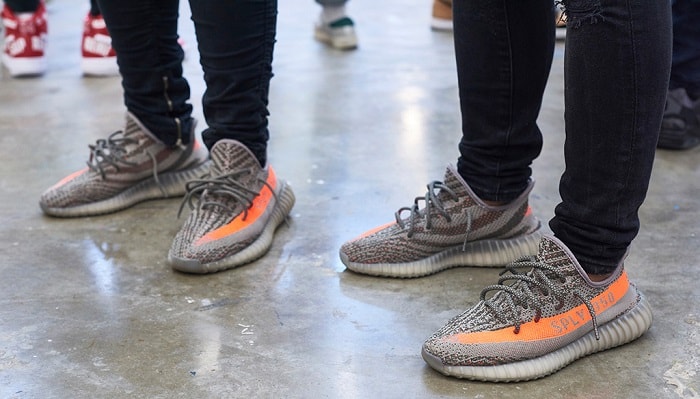
Take a classic example from the September 2016 release calendar. The Adidas Yeezy Boost 350 V2 “Beluga” (BB1826) launched in 2016 for $220 retail. Deadstock pairs eventually climbed past $1,000+ on GOAT per market data. Casual buyers who wanted the solar-red stripe without paying five times retail turned to $200 unauthorized replicas instead. That fivefold price gap fuels replica demand across every major sneaker franchise.
Who Manufactures High-End Replicas and Bootleg Lookalikes?
Gone are the days when counterfeits were limited to $50 swap-meet shoes stamped with “Abidas” or “Mike” logos. Over the past decade, underground workshops in Putian, China acquired industrial last molds, Primeknit looms, and full-grain leather presses. High-tier “UA” (Unauthorized Authentic) batches priced between $140 and $200 replicate stitch counts, box labels, and UV glue stamps closely.
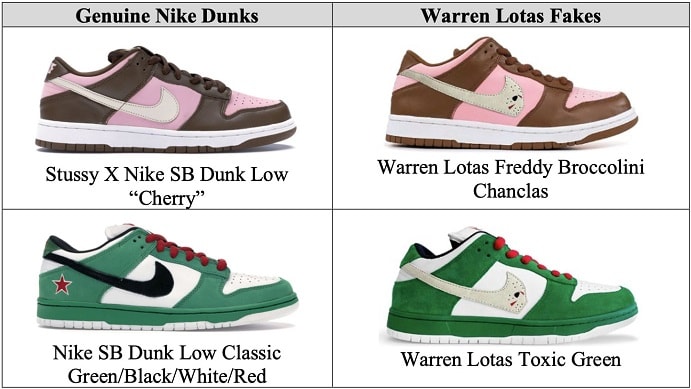
At the same time, a wave of Instagram bootleg brands began selling $200 to $300 “original” sneakers. Those pairs were built directly on 1985 silhouettes created by legendary sneaker designers like Peter Moore. Bootleggers copied the exact toe-box perforations, heel panels, and cupsole tooling of the Air Jordan 1 or Dunk Low while swapping the side emblem. That practice blurred the line between homage and trademark infringement.
“When $220 retail releases trade above $1,000 on the aftermarket, $200 high-tier replicas test every collector’s eye.” – Footwear Authentication Review
What Happened in the 2020 Warren Lotas Trademark Lawsuit?
That bootleg wave hit a legal wall in October 2020. Designer Warren Lotas opened pre-orders for $300 retail low-top sneakers. Those pairs mirrored the 2005 Jeff Staple NYC Pigeon SB Dunk Low and “Heineken” Dunk while swapping the side logo for a hockey mask. Per Footwear News coverage of the Warren Lotas lawsuit, Beaverton’s legal team filed a federal trademark infringement complaint immediately.
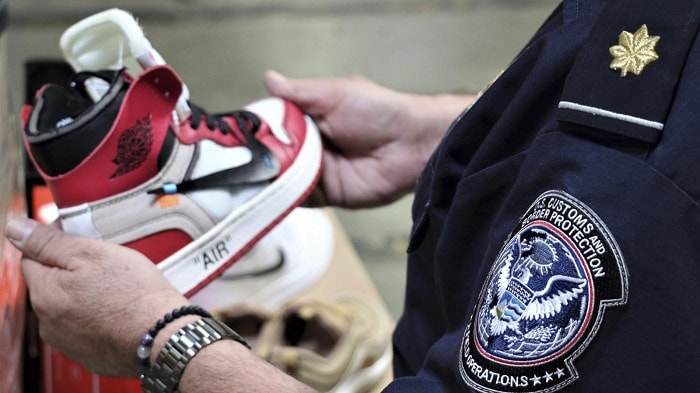
Federal courts granted a preliminary injunction blocking fulfillment of the $300 retail pre-orders. That 2020 ruling proved that registered trade dress covers the entire paneling and outsole geometry of the Dunk. It protects far more than just the side check mark. Since then, additional trademark suits in 2021 and beyond have shut down commercial bootleg factories and large-scale replica distributors.
How Can Buyers Avoid Getting Sneakerfished on the Aftermarket?
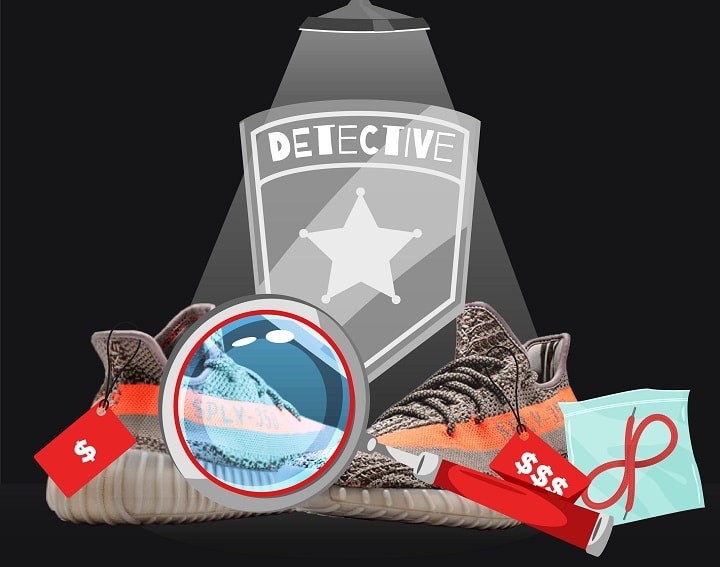
Taking a loss on release morning often tempts collectors to hunt for deals on peer-to-peer classifieds. Before sending money to an unverified seller, read our guide on how to buy and sell sneakers safely. First, verify whether the asking price makes sense. A deadstock Yeezy Boost 350 V2 “Static Black” listed for $150 when market value sits above $350 is a guaranteed counterfeit.
Second, always request tagged high-resolution photos of the interior size label, insole underside, footbed stitching, and box UPC font. Third, use digital verification tools before meeting a local seller. As detailed in Hypebeast’s breakdown of the CheckCheck app, mobile authentication services combine AI image scanning with human specialists. They return a pass-or-fail verdict within 30 minutes for a few dollars.
| Inspection Checkpoint | Authentic Factory Standard | Common $150-$200 Replica Flaw | Verification Tool Needed |
|---|---|---|---|
| Asking Price vs. Market | Within 5% – 10% of StockX/GOAT bid | Listed at $150 on a $400+ release | Live market bid-ask lookup |
| Interior Tongue Size Tag | Crisp thermal print & exact SKU date | Thick bold font & mismatched date | Macro camera + CheckCheck app |
| Midsole & Upper Glue Line | Clean bond under 365nm UV light | Sloppy fluorescent glue marks & stamps | Handheld 365nm UV blacklight |
| Strobel & Insole Stitching | Even, tight radial thread spacing | Loose, frayed threads under insole | Removable insole inspection |
How Do Authenticated Marketplaces and Seller Fees Protect Collectors?
The safest way to trade aftermarket pairs without getting “sneakerfished” is to use middleman authentication hubs. Readers studying where and how to resell sneakers rely on eBay Authenticity Guarantee, StockX, and GOAT. Every pair passes physical warehouse inspection before funds release. In exchange for that anti-counterfeit protection, platforms deduct a commission from the seller’s payout. That verification fee eliminates buyer uncertainty.
Per eBay athletic shoe fee schedules, sneakers sold for $150 or more incur an 8% final value fee. Meanwhile, StockX seller fee schedules charge Level 1 sellers a 9% base fee plus 3% payment processing (12% total). On a $1,000 Yeezy Beluga sale, eBay nets $920 while StockX nets $880. Both platforms shield the buyer from $200 replicas completely.
| Marketplace / Channel | Authentication Protocol | Seller Commission ($150+ Shoe) | Net Payout on $400 Sale |
|---|---|---|---|
| eBay Authenticity Guarantee | Multi-point physical inspection + NFC tag | 8% flat final value fee | $368.00 net (-$32.00 fee) |
| StockX Verification Center | In-hand warehouse verification | 9% base + 3% processing (12%) | $352.00 net (-$48.00 fee) |
| GOAT Authenticated Shipping | In-hand specialist + optical scan | 9.5% + $5 + 2.9% cash-out | $346.69 net (-$53.31 fee) |
| Unverified Peer Classifieds | None (buyer must use CheckCheck app) | 0% – 3% payment app fee | High chargeback / replica risk |
How Does Buying at Retail Eliminate Counterfeit Risk Completely?
Authentication apps and middleman marketplaces catch the vast majority of fakes on the secondary market. Even so, the only 100% foolproof way to guarantee authenticity is buying directly from authorized retailers on drop day. Checking out at retail also avoids $400 to $1,000+ resale markups. Every pair shipped from Nike SNKRS, Foot Locker, or an authorized Shopify boutique arrives factory-direct at its $115 to $225 MSRP.
Securing hyped limited-edition sneakers at retail requires speed when stock vanishes in seconds at 10:00 AM EST. Experienced collectors compare multi-site checkout platforms such as Valor AIO, Cybersole, and Stellar AIO alongside NikeShoeBot. Running automated tasks with clean residential proxies across SNKRS, Footsites, and Shopify lets buyers secure authentic pairs at retail. Pre-saving billing profiles eliminates manual checkout delays.
What does “UA” (Unauthorized Authentic) mean when sellers describe replicas?
“Unauthorized Authentic” is a marketing term used by replica sellers for high-tier $150-$200 counterfeits. Despite claims that they come from official factories, they are still unauthorized knockoffs that fail authentication.
Can a 365nm UV blacklight flashlight detect counterfeit sneakers at home?
Yes, shining a 365nm UV flashlight along the midsole and upper reveals invisible Chinese factory ink stamps. It also exposes dashed pattern tracing lines and excess glue marks common on replicas.
Tagged