How Many Sneaker Bot Tasks Should You Run to Score Kicks?

Configuring sneaker bot tasks around a 50 to 100 worker baseline paired with a 1:1 proxy ratio determines how many threads you should run to score kicks. Each automated worker executes an independent checkout sequence. It monitors inventory, carts a target size, and submits payment details within 2 to 5 seconds.
- Standard Baseline: Most everyday operators run 50 to 100 checkout workers per release across Shopify, Footsites, and specialty boutiques.
- Golden Proxy Rule: Maintaining a 1:1 proxy-to-worker ratio (100 IP addresses for 100 workers) prevents entire subnet bans when edge firewalls throttle traffic.
- Hardware Ceilings: While desktop applications like Valor AIO, Cybersole, Stellar AIO, and NikeShoeBot allow unlimited worker creation, 16GB RAM systems typically cap smooth execution around 250 to 500 concurrent threads.
- Bandwidth Costs: Residential proxy pools priced at $8 to $15 per gigabyte according to provider rate cards consume 1.5GB to 4GB per 100 workers during a 45-minute Footsites queue.
What Are Sneaker Bot Tasks and How Do They Execute?
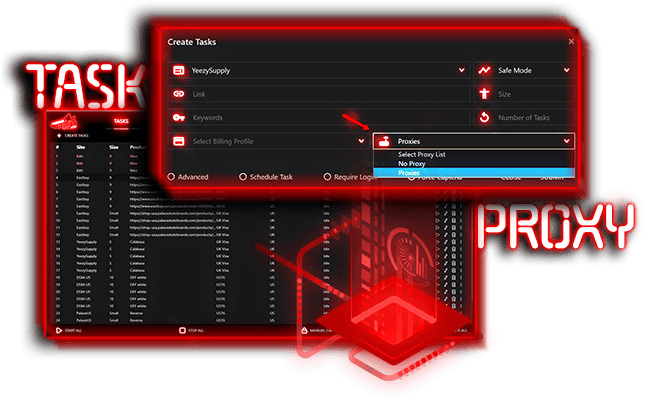
A checkout worker is an individual instruction thread inside automated desktop software that sends HTTP requests to a store server. Each worker carries four core parameters: a target URL or keyword, a shoe size, a proxy IP, and a billing profile. When a release begins, every active worker independently polls the product page. It then adds the item to a session cart and submits payment credentials.
Running multiple workers in parallel increases checkout probability when 40,000 shoppers compete for 1,200 pairs of limited footwear. According to Cloudflare bot management documentation, edge firewalls inspect TLS handshakes, request velocity, and IP reputation. Those signals help security engines score incoming automated traffic. A foundational sneaker bot cooking guide helps operators separate monitoring threads from checkout threads before launch time.
How Many Tasks Should You Run per Footwear Release?
The average operator runs between 50 and 100 checkout workers per footwear drop to balance queue coverage against proxy bandwidth. On regional Shopify boutiques where checkpoints activate within 3 seconds, 15 to 30 timed workers work best. Those threads use pre-harvested CAPTCHA tokens to outperform 300 unauthenticated workers. High-volume Footsites drops with 15,000+ pairs reward 100 to 250 residential workers rotating through waiting rooms.
Under Federal Trade Commission online shopping rules, retail storefronts enforce strict per-customer quantity limits in their terms of service. Running 100 workers against a single credit card and street address triggers duplicate order cancellations after the first confirmation. Experienced buyers pair 50 to 100 workers with 5 to 15 unique billing profiles. They also set per-profile checkout limits to 1 pair.
| Storefront Category | Recommended Worker Count | Ideal Polling Delay | Recommended Proxy Type |
|---|---|---|---|
| Shopify Boutiques (Kith, Undefeated) | 15 – 40 workers per site | 2,500ms – 3,500ms | Unbanned ISP or DC Proxies |
| Footsites (Foot Locker, Champs) | 50 – 150 workers per site | 3,000ms – 4,500ms | Rotating Residential Proxies |
| Demandware (Finish Line, JD Sports) | 40 – 100 workers per site | 3,500ms – 5,000ms | Static Residential / ISP Proxies |
| Supreme Weekly Thursday Drops | 10 – 25 workers per item | 1,500ms – 2,500ms | Low-Latency ISP Proxies |
Why Is the 1-to-1 Proxy Ratio the Golden Botting Rule?
A 1:1 proxy-to-worker ratio assigns exactly one unique IP address to each active checkout thread during a release. If an operator launches 75 workers for a Saturday drop, the proxy list needs 75 distinct IP addresses. Pairing each thread with its own sneaker proxies endpoint masks concurrent activity. Every checkout attempt then appears to the retail server as an independent household shopper.

Sharing a single IP address across 5 or 10 concurrent workers multiplies outbound HTTP request frequency by 500% to 1,000% per calculation. E-commerce firewalls immediately flag the spike and return HTTP 429 Too Many Requests blocks. Some servers also issue HTTP 403 Forbidden bans for the entire release window. When one shared IP gets throttled, all 10 attached workers fail simultaneously. A 1:1 ratio isolates any single block to just 1 thread.
What Limits Unlimited Task Counts on Desktop Setups?
Hardware memory, processor core counts, and residential proxy data budgets impose strict physical ceilings on unlimited software licenses. Desktop platforms like Valor AIO, Cybersole, Stellar AIO, and NikeShoeBot do not hard-code a maximum worker limit. Even so, launching 500 concurrent workers on an 8GB laptop saturates CPU threads. That overload freezes local network sockets mid-drop.
Evaluating the full cost of sneaker bots requires adding monthly proxy bandwidth and virtual machine rentals to the software budget. A 100-worker Footsites setup consumes 2GB to 3.5GB of residential data per drop at $8 to $15 per gigabyte according to provider pricing schedules. Operators scaling beyond 250 threads routinely rent dedicated sneaker servers for drop days. Those remote machines provide 16 to 32 vCPU cores and 10Gbps fiber uplinks.
“Software licenses may permit unlimited workers on paper, but a clean 75-thread setup running at a 1:1 proxy ratio on 16GB of RAM consistently beats 400 throttled threads starving for CPU cycles and residential bandwidth.”
How Do Request Tasks Compare With Browser Threads?
Automated checkout software executes workers in either lightweight HTTP request mode or headless Chromium browser mode depending on site security. Request-based workers exchange compact JSON and HTML payloads directly with cart endpoints. They consume only 15MB to 35MB of system RAM per active worker. That low memory footprint lets a standard 16GB desktop run 200 to 350 request workers simultaneously without frame drops.
Browser-based workers launch a full headless Chromium instance to execute client-side JavaScript challenges and pass behavioral fingerprinting checks. They also render interactive 3D Secure payment prompts during card verification. Each browser thread consumes 150MB to 350MB of RAM and 5 to 10 times more proxy data than a raw HTTP worker. Operators reserve browser threads for strict checkpoint releases and cap concurrency at 15 to 40 sessions per machine.
| Hardware / VPS Tier | CPU & Memory Specs | Max HTTP Request Workers | Max Browser / Headless Workers |
|---|---|---|---|
| Entry Home Laptop | 4 Cores / 8GB RAM | 50 – 100 workers | 5 – 12 browser sessions |
| Mid-Range Desktop PC | 8 Cores / 16GB RAM | 150 – 300 workers | 15 – 30 browser sessions |
| Workstation / Entry VPS | 16 Cores / 32GB RAM | 350 – 600 workers | 35 – 65 browser sessions |
| Bare-Metal Sneaker Server | 32 Cores / 64GB RAM | 750 – 1,200 workers | 70 – 120 browser sessions |
How Did Nike DTC Shifts Change Release Task Strategy?
Footwear distribution changed markedly after 2020 and 2021 when major brands shifted inventory away from third-party wholesalers. According to Nike’s Consumer Direct Acceleration announcement, the company reorganized its marketplace strategy around direct digital sales and membership apps. That Nike direct to consumer pivot reduced pair allocations at regional mall chains. It simultaneously concentrated limited stock on flagship apps and tier-zero boutiques.
Digital experiments like sneakers in the metaverse also introduced virtual collectibles across 2021 and 2022. Meanwhile, physical footwear drops increasingly adopted randomized entry windows. Under Nike SNKRS Draw guidelines, buyers enter a timed countdown window. The system then sends selection notifications within a few minutes after the draw closes. For draw-style releases, account trust scores and verified payment profiles matter far more than raw HTTP polling speed.
Can running too many workers on one home internet connection crash your Wi-Fi?
Yes. Launching 200 or more concurrent checkout workers over a consumer Wi-Fi router can exhaust the router’s NAT connection table. That bottleneck causes packet loss and high latency for every device on the local network unless you use wired Ethernet or a remote server.
Should monitor threads use the same proxies as checkout workers?
No. Operators separate monitor pools from checkout pools by assigning 5 to 10 unbanned static ISP proxies exclusively to monitor threads. Residential or clean ISP proxies remain on standby for checkout workers so carting IPs never get rate-limited before the drop goes live.