Nike Kids Size Change: New TD, PS & GS Shoe Charts and $20 Price Shift

The 2024 Nike kids size change restructures youth shoe size charts across Toddler, Little Kids, and Big Kids brackets. Retail prices will also change for transitional pairs. Moving sizes 1Y through 3Y out of PS and into GS eliminated overlapping labels. That shift raises 1Y to 3Y retail prices by $20 per pair.
- Updated Toddler (TD) Range: Adjusted from the legacy 1C to 7C bracket to a streamlined 2C to 7C size chart.
- Updated Little Kids (PS) Range: Narrowed from 8C-13.5C and 1Y-3Y down to 8C through 13.5C only ($65 to $75 retail tier).
- Expanded Big Kids (GS) Range: Expanded from 3.5Y-7Y to cover all Youth sizes from 1Y through 7Y ($85 to $90 retail tier).
- Retail Price Impact: Sizes 1Y to 3Y shifted from $65-$75 PS pricing to $85-$90 GS pricing, creating a $20 retail gap.
What Changed in the 2024 Nike Kids Size Change Across TD, PS, and GS?
The Nike kids size change rolled out in Spring 2024 to resolve confusion across youth footwear categories. Those three brackets are Toddler (TD), Pre-School or Little Kids (PS), and Grade School or Big Kids (GS). Previously, Little Kids (PS) spanned two different scales: 8C to 13.5C plus 1Y to 3Y.
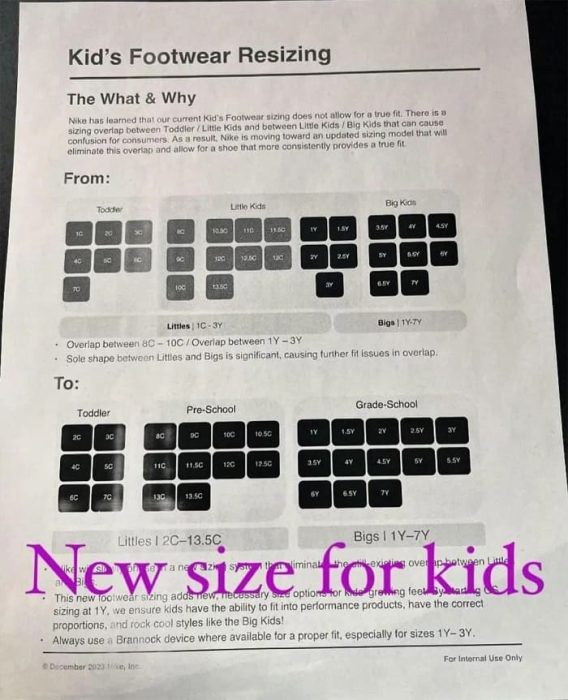
Parents shopping online often struggled to tell whether a size 1Y or 2Y belonged in Little Kids or Big Kids. To create a clean boundary, the Swoosh assigned all “C” sizes to TD and PS. Every “Y” size now sits inside the GS bracket.
Shoppers who want to verify foot length before ordering can read our guide on how to measure your shoe size at home. Measuring heel-to-toe length in centimeters prevents ordering errors.
How Do the Old and New Nike Youth Size Charts Compare Side by Side?
Under the legacy chart used prior to 2024, Toddler (TD) covered 1C to 7C. Little Kids (PS) covered 8C to 13.5C plus 1Y to 3Y, while Big Kids (GS) covered 3.5Y to 7Y. Under the updated 2024 chart, the brand removed size 1C from the standard Toddler run so TD now spans 2C through 7C.
The PS bracket now stops cleanly at 13.5C, covering only 8C through 13.5C. Meanwhile, the GS bracket now begins at 1Y and runs continuously through 7Y. Physical foot lengths for each numeric size remain identical in centimeters. A child who wore a 2Y in 2023 still wears a 2Y under the new chart.
According to the Nike Global Manufacturing Map, the company coordinates footwear production across more than 500 contract factories. Those independent manufacturing plants operate in 41 countries worldwide. Standardizing the boundary between “C” lasts and “Y” lasts simplifies tooling allocation across global assembly lines.
| Youth Size Category | Legacy Size Range | Updated 2024 Size Range | Standard Retail Price Tier |
|---|---|---|---|
| Toddler (TD / Baby) | 1C to 7C | 2C to 7C | $50 to $65 Retail |
| Little Kids (PS Tier) | 8C to 13.5C & 1Y to 3Y | 8C to 13.5C Only | $65 to $75 Retail |
| Transitional Youth Bracket | 1Y to 3Y (Priced as PS) | 1Y to 3Y (Moved to GS) | Shifted from $65-$75 to $85-$90 |
| Big Kids (GS Tier) | 3.5Y to 7Y | 1Y to 7Y Complete | $85 to $90+ Retail |
Why Did Moving Sizes 1Y to 3Y Into the GS Tier Add a $20 Price Gap?
While the 2024 Nike kids size change made the chart easier to read, moving sizes 1Y through 3Y into GS triggered a retail price jump. Previously, a size 2Y Dunk Low or Air Force 1 was classified as a PS shoe. Those pairs retailed between $65 and $75 depending on the model.
Because sizes 1Y, 1.5Y, 2Y, 2.5Y, and 3Y now sit inside the GS bracket, they carry the full GS retail rate. That updated bracket prices pairs at $85 to $90. This reclassification creates a $15 to $20 price increase per pair for families buying sizes 1Y to 3Y.
On the engineering side, 1Y to 3Y pairs on select silhouettes receive upgraded GS tooling. Many models gain encapsulated Air units instead of flexible PS foam soles.
How Does the Size Chart Update Affect Secondary Market Youth Pairs?
The $20 retail shift on sizes 1Y through 3Y also alters baseline cost calculations on secondary marketplaces. Larger GS sizes from 3.5Y to 7Y convert directly to Women’s sizes 5 to 8.5. That overlap makes them popular among youth wearers and women shopping for collectible footwear editions. By contrast, sizes 1Y to 3Y primarily serve elementary-age children.
When sellers list GS pairs on authenticated exchanges, platform commissions apply to the final sale price. According to GOAT’s official seller fee schedule, sellers in good standing pay a 9.5% base commission rate. The platform also deducts a regional fee and a 2.9% cash-out fee. A size 2Y pair priced at $90 retail must trade above $103 on GOAT to clear retail cost after 12.4% fees.
| Shoe Size & Bracket | Pre-2024 Retail Price | Updated 2024 Retail Price | Break-Even Resale Ask (After ~12.4% GOAT Fees) |
|---|---|---|---|
| Size 10C (Little Kids PS) | $70 | $70 (Unchanged) | $80 Gross ($70 Net) |
| Size 2Y (Legacy PS vs. New GS) | $70 (Legacy PS Tier) | $90 (New GS Tier) | $103 Gross ($90 Net) |
| Size 3Y (Legacy PS vs. New GS) | $65 to $75 | $85 to $90 (+$20 Gap) | $97 to $103 Gross |
| Size 6Y (Big Kids GS) | $90 | $90 (Unchanged) | $103 Gross ($90 Net) |
How Can Parents and Small-Footed Buyers Measure Nike Kids Sizes Accurately?
Children’s feet grow rapidly between ages four and eight. Measuring foot length in centimeters (CM) is the best way to navigate the Nike kids size change. On the official size chart, size 13.5C measures 19.5 cm in foot length, while size 1Y measures 20.0 cm.
“Separating all C sizes into Little Kids and all Y sizes into Big Kids removes checkout confusion, even as 1Y to 3Y shoppers absorb a $20 retail bump.”
For adults with smaller feet who shop sizes 3.5Y to 7Y, the 1.5-size conversion rule remains unchanged. A Youth size 6Y equals a Men’s size 6 and a Women’s size 7.5. Meanwhile, many youth outsoles use recycled rubber from Nike Grind’s sustainability program. That program has repurposed manufacturing scrap into footwear soles since 1992.
How Do Shoppers Secure Full-Family Nike and Jordan Releases at Retail?
Securing full-family Dunk, Air Jordan, and Kobe Protro releases across Adult, GS, PS, and TD brackets requires preparation. Shoppers looking to buy sneakers for retail often face fast sellout times on popular Youth sizes 4Y through 7Y. Setting up family size preferences in SNKRS and entering boutique raffles early improves retail access.
Buyers who use automated checkout software across multi-store releases evaluate all-in-one sneaker bots before major drops. In the sneaker automation market, platforms such as Valor AIO, Cybersole, and Stellar AIO compete alongside NikeShoeBot. These tools operate across Shopify boutiques, Footsites, and regional footwear modules.
Shoppers preparing for full-family footwear drops can visit NikeShoeBot to review supported retail modules and checkout task guides.
What are the new size ranges for Toddler, Little Kids (PS), and Big Kids (GS) shoes?
Under the 2024 update, Toddler (TD) covers 2C to 7C, Little Kids (PS) covers 8C to 13.5C, and Big Kids (GS) covers 1Y to 7Y.
Why did youth shoes in sizes 1Y to 3Y increase in price by $20?
Sizes 1Y through 3Y moved from the PS category ($65 to $75 retail) into the GS category ($85 to $90 retail), resulting in a $15 to $20 price increase per pair.