AMD Bots and GPU Launches: Radeon Prices, Sell-Outs and Safeguards

AMD bots are checkout bots pointed at Radeon graphics cards (GPUs): programs that repeat the steps of an order the moment a retailer opens a sale. On 18 November 2020, PCMag reported that the Radeon RX 6800 and RX 6800 XT sold out within minutes of going on sale, four weeks after it had reported AMD’s letter urging retail partners to add bot protection. According to AMD’s own press release, the Radeon RX 6800 launched at $579.
- $579: the launch price of the Radeon RX 6800, according to AMD’s press release of 28 October 2020.
- 18 November 2020: the on-sale date AMD gave for the RX 6800 and RX 6800 XT, which PCMag’s launch report confirms.
- Safeguards AMD urged: real-time bot detection, plus a CAPTCHA test, one card per customer and an online queue, as PCMag reported on 22 October 2020.
- 15 September 2022: the date Ethereum completed The Merge, according to ethereum.org.
What are AMD bots?
AMD bots are checkout bots set up for the sale pages of AMD’s own store and of the retailers that sell Radeon cards. They repeat the steps of an order, from adding the card to the cart to sending payment details, without the pauses of a person clicking. Launch sales leave little room for pauses: PCMag found that Newegg’s Radeon RX 6800 listings appeared around 6:05 a.m. Pacific on 18 November 2020, and by then all the stock was gone.

None of the sources we read gives a count of how much Radeon stock bots actually bought. Shares that circulate as forum screenshots are not something we can check, so this page does not quote one.
Our overview of GPU bots and our explainer on retail bots are the places to start for how the same idea works with other products.
How much did Radeon cards cost at launch?
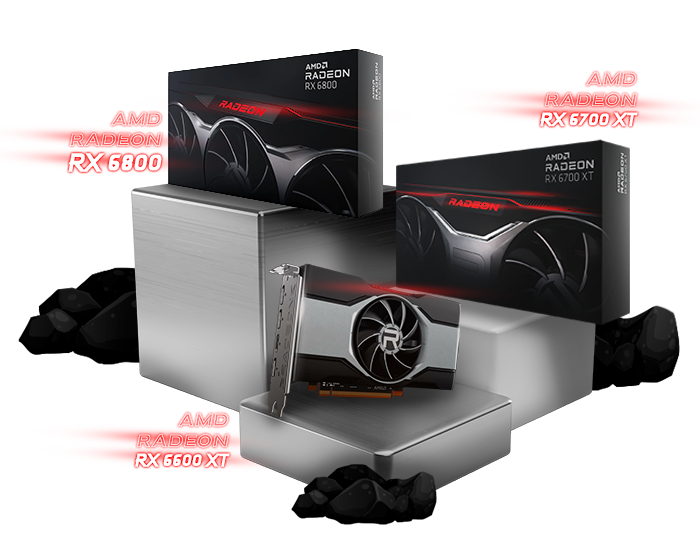
AMD set the Radeon RX 6900 XT at $999, the RX 6800 XT at $649 and the RX 6800 at $579, according to its press release of 28 October 2020. According to Eurogamer on 3 March 2021, the RX 6700 XT followed at $479, and according to PC Gamer in July 2021, the RX 6600 XT at $379.

The table lists each launch price in US dollars with the on-sale date the company stated and where we read it.
Card Launch price (USD) On-sale date as stated Where we read it Radeon RX 6900 XT $999 8 December 2020 AMD press release, 28 October 2020 Radeon RX 6800 XT $649 18 November 2020 AMD press release, 28 October 2020 Radeon RX 6800 $579 18 November 2020 AMD press release, 28 October 2020 Radeon RX 6700 XT $479 18 March 2021 Eurogamer, 3 March 2021 Radeon RX 6600 XT $379 11 August 2021 PC Gamer, July 2021 List price and shelf price had already parted ways by 2021: the PC Gamer report on the RX 6600 XT from July 2021 said the RX 6700 XT “would usually sell for $479 MSRP if it weren’t for the ongoing chip shortage”. Market prices move and are shown for reference, not as a promise.
Were Radeon cards cheaper than Nvidia’s?
Radeon launch prices were not clearly lower than Nvidia’s in the two comparisons we read. According to Eurogamer, the $479 Radeon RX 6700 XT was pitched against the $399 RTX 3060 Ti and the $499 RTX 3070, which places it between the two.
PC Gamer’s report made a similar comparison for the smaller card, noting that the RTX 3060 12GB launched at an MSRP of $329 while the Radeon RX 6600 XT began at $379. It added that the company would need “a decent lead” in performance to win that match-up at the higher price.
So the answer depends on the match-up. At launch the RX 6700 XT was $20 below the RTX 3070 ($499 minus $479) and $80 above the RTX 3060 Ti ($479 minus $399), and the RX 6600 XT was $50 above the RTX 3060 12GB ($379 minus $329).
Why did Radeon cards sell out at launch?
The statements from launch day point to heavy demand and limited stock rather than to one cause. PCMag tried to order from Newegg and AMD’s own store at 6 a.m. Pacific on 18 November 2020 and wrote that “all we saw were out-of-stock notices on both websites”.
Frank Azor, AMD’s Chief Architect of Gaming Solutions and Marketing, rejected the label paper launch in a tweet PCMag quoted: “We are producing chips and cards in volume.” He added that demand for gaming devices had grown beyond anyone’s best forecasts.
Retailers handled the launch differently. PC Gamer reported that Micro Center limited all Radeon RX 6800 series sales to in-store only, and PCMag found that B&H Photo Video was not taking orders for the cards.
How did AMD try to stop bots?
The company asked its retail partners to add safeguards before the Radeon RX 6000 launch, including real-time bot detection, a CAPTCHA test, a limit of one card per customer and an online queue. PCMag reported the request on 22 October 2020, drawing on a leaked letter, and said AMD was only “strongly” recommending the measures.
PCMag quoted one of the letter’s reasons for the request:
We expect that some purchasers (scalpers) may initially try to buy large quantities of our new graphics and processor cards and re-sell them at higher prices in the secondary market.
PCMag added that Newegg said it already used some of the advised safeguards, and that AMD had not responded to a request for comment when the story ran. If you want to know why shops use a CAPTCHA, our explainer on what a CAPTCHA is covers it.
What changed after 2022
Ethereum completed The Merge on 15 September 2022, according to ethereum.org, which says the change “eliminated the need for energy-intensive mining” and cut energy consumption by about 99.95%. The same page gives GPU hash power as one example of the economic resources committed under proof-of-work. None of the sources we read measures what this did to Radeon prices, so we make no claim about it.
As of 6 October 2026, AMD’s Radeon graphics page features the RX 9070 XT, RX 9070, RX 9070 GRE and RX 9060 XT. According to PC Gamer on 29 July 2026, AMD quoted $279 for the Radeon RX 9050 in the APJ and Latin American markets, a release limited to certain regions. Those names belong to the RX 9000 series, a different generation from the RX 6000 cards in the table above.
Where can you buy a Radeon card?
AMD’s own graphics page, read on 6 October 2026, points shoppers to a retailer finder and notes that availability depends on region. Each store then sets its own stock notices, order limits and queue rules, so reading those rules before a sale opens is the useful preparation. They also show whether a store runs a queue, which is one of the safeguards described above.
Whatever you use, read the store’s terms first, since each retailer sets its own rules on automated orders. Keeping your delivery and payment details saved shortens the order form either way.
If you want to see what a checkout bot does with this, NikeShoeBot’s guides walk through it retailer by retailer. For the non-bot route, our general guide to buying a graphics card covers where to look and what to compare.
Why does this page not rank bots for graphics cards?
Ranking bots needs a sourced, repeatable test, and none of the sources we read offers one for graphics-card launches. This page sticks to prices, dates and statements we could read.
Are these still the prices to expect?
No. They are launch prices from 2020 and 2021, and shelf prices move. For a price you can act on, check the retailer’s own page on the day.